
Therapy as the #1 use of LLMs in 2025. What the Harvard Business Review data shows.
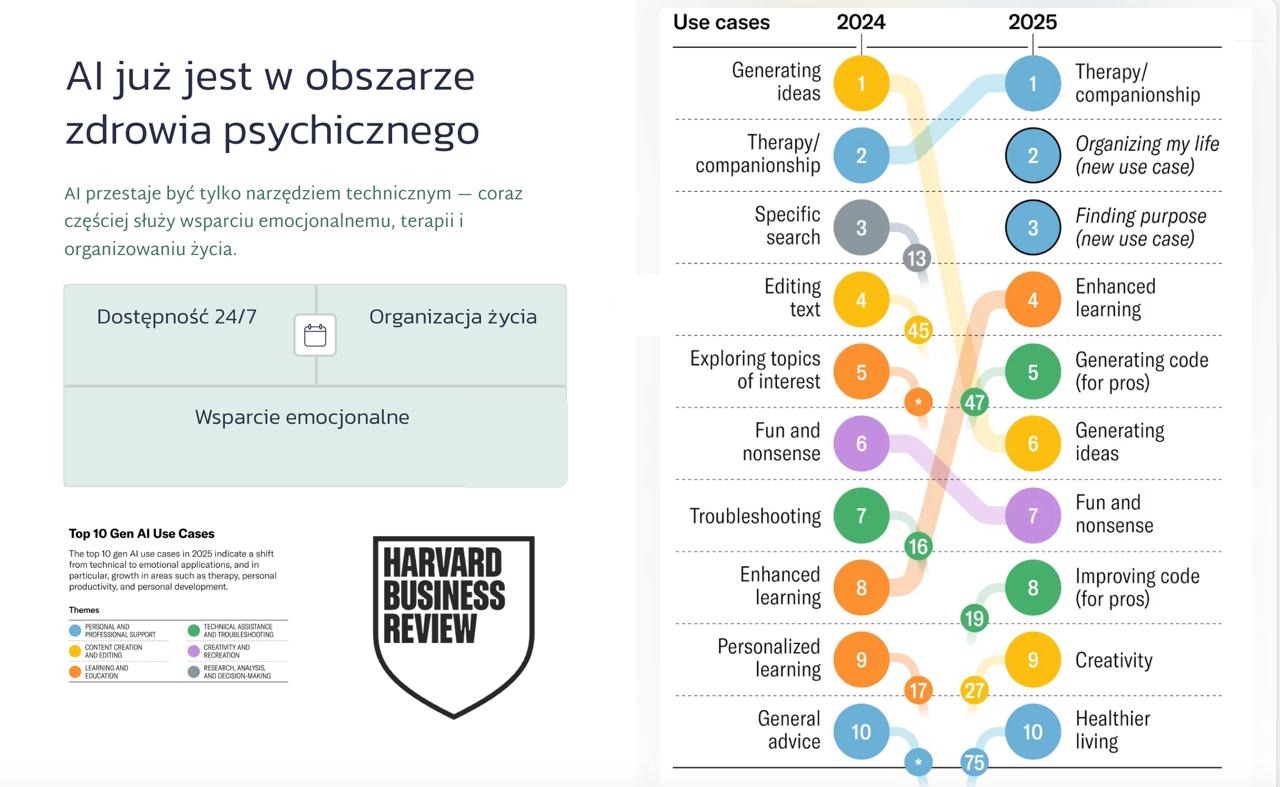
In April 2025 Harvard Business Review published the second edition of its report on how people really use large language models (LLMs). The top entry on the list of the hundred most common uses is not writing code, not producing marketing content, not even learning. The top entry is therapy and companionship. Three of the five most common uses - therapy, organising one’s life, and finding purpose - are self-actualising and emotional in nature. This is a clear shift from 2024, when the top five were dominated by technical and creative uses.
What the data actually shows
The report’s author, Marc Zao-Sanders, is a co-founder of filtered.com, a company building AI-based solutions - a conflict of interest worth keeping in mind while reading. The report’s methodology rests on a qualitative analysis of posts on Reddit and Quora and of user quotes, with an expert assessment of perceived usefulness and scale of impact. This is an important limitation: the study does not show how many people across the population use LLMs in a therapeutic way, or with what health outcomes. What it does show is a clear pattern: users talk about these tools in language until now reserved for helping relationships.
The top ten reads as follows: therapy and companionship, organising one’s life, finding purpose, supporting learning, generating code, generating ideas, fun and nonsense, fixing code, creativity, healthier living. Within the first category the author distinguishes two phenomena - therapy, understood as structured support in working through psychological difficulties, and companionship, understood as an ongoing social and emotional bond. They are grouped together because both answer a fundamental human need.
Three layers of reflection for the profession
The regulatory layer. Publicly available language models are not medical devices within the meaning of the European MDR (Medical Device Regulation). They are not subject to clinical efficacy validation, they carry no obligation to report adverse events, and their providers bear no clinical responsibility for conversations with users. Yet users often treat them as a quasi-therapist - describing symptoms, sharing trauma, asking for interpretations of dreams or conflicts. A gap opens up between how the tools are actually used and the regulatory frameworks in force.
The ethical layer. A relationship with an LLM involves no informed consent to participate in a therapeutic process in the sense of professional standards. There is no continuity of relationship, no supervision, no professional boundary. Nor is there any certainty about confidentiality - the report’s author himself notes that these tools cannot replace professional care or guarantee data privacy. The user quotes cited in the report include material concerning trauma, neurological injury and family shame - the kind of material that in the consulting room would call for careful conceptualisation and supervisory oversight.
The clinical and didactic layer. CBT psychotherapists will recognise a pattern here worth naming. Consulting an LLM can encourage cognitive offloading - the external delegation of intellectual and emotional work whose development is the very aim of many therapeutic interventions. In patients with emotional dysregulation it reinforces a pattern of seeking immediate relief. For early-stage trainee therapists the risk is analogous: an anchoring effect on hypotheses generated by the model before independent clinical thinking has had a chance to form.
On the other hand, the HBR data shows the scale of an unmet need. The barriers to accessing professional psychotherapy - financial, geographic, competence-related, cultural - are real. If hundreds of millions of people around the world are seeking psychological support in a tool that lacks clinical validation, then the conclusion for the profession should not be to condemn the phenomenon, but to ask how to increase access to sound help.
Where Therapy Support sits in this landscape
Therapy Support is not a tool described in the HBR report. It is not a therapeutic chatbot for the patient. It does not replace a conversation with a psychotherapist. It is an AI platform for the therapist - an assistant that organises session documentation, extracts the fragments relevant to case conceptualisation, proposes a structure for the clinical note, and handles the calendar and billing.
The boundary is clearly drawn at the product and communication level: AI proposes the material, the therapist decides clinically. A note generated by the model is a starting point for editing and verification, not a finished interpretation. A cognitive diagram, a vicious-cycle model or an ABC analysis are produced as working material for further conceptualisation, not as a diagnosis.
In the context of the HBR data this framing takes on added significance. If the scale of patients’ needs is so great that they seek support in tools without clinical oversight, then on the professionals’ side the therapist’s time grows in value. Time which today - according to our validation research from 14 interviews with psychotherapists - consumes ten to fifteen hours of administrative and documentation work per month. Time that could be redirected to working with patients.
Conclusion
The Harvard Business Review report is not an argument for replacing psychotherapy with artificial intelligence. It is a diagnosis of a social phenomenon: people look for help where they can find it, at a pace and in a form suited to their daily lives. The conclusion for the profession should be a conversation about two parallel tasks - increasing access to professional therapy, and clearly drawing the line between what technology can support and what remains within the therapist’s competence.
For us, as a team building tools for CBT therapists, it is a confirmation of direction. The HBR data lends credibility to the hypothesis that the unmet need for psychological support is the scale of the phenomenon, not a margin of it. And that it is all the more important to work towards giving the therapist - the person who answers that need in a safe and substantive way - more time, a better structure of work, and less administrative burden.
This text analyses published market data and does not constitute a product recommendation. Therapy Support is not a medical device within the meaning of the MDR and does not make clinical decisions. The AI in the platform supports documentation and the organisation of material - all clinical decisions remain with the therapist.
Source: Marc Zao-Sanders, How People Are Really Using Gen AI in 2025, Harvard Business Review, 9 April 2025, hbr.org/2025/04/how-people-are-really-using-gen-ai-in-2025.